
|
Tales of Stream Monitoring Fun
|

|
|
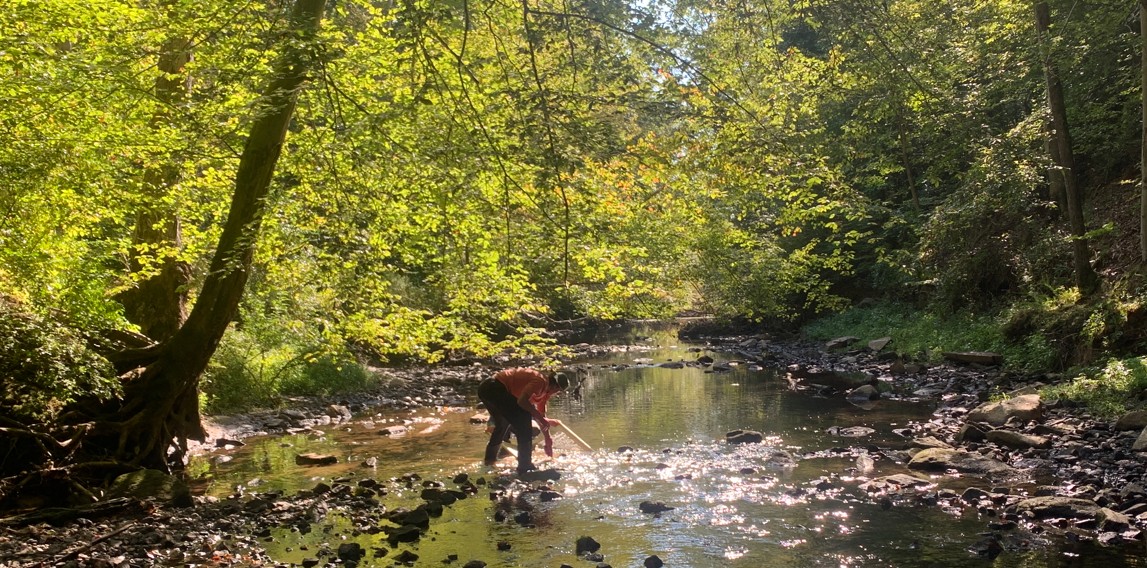
Friends of Accotink Creek and Friends of Lake Accotink Park hold biological stream monitoring workdays four times per year. |
|
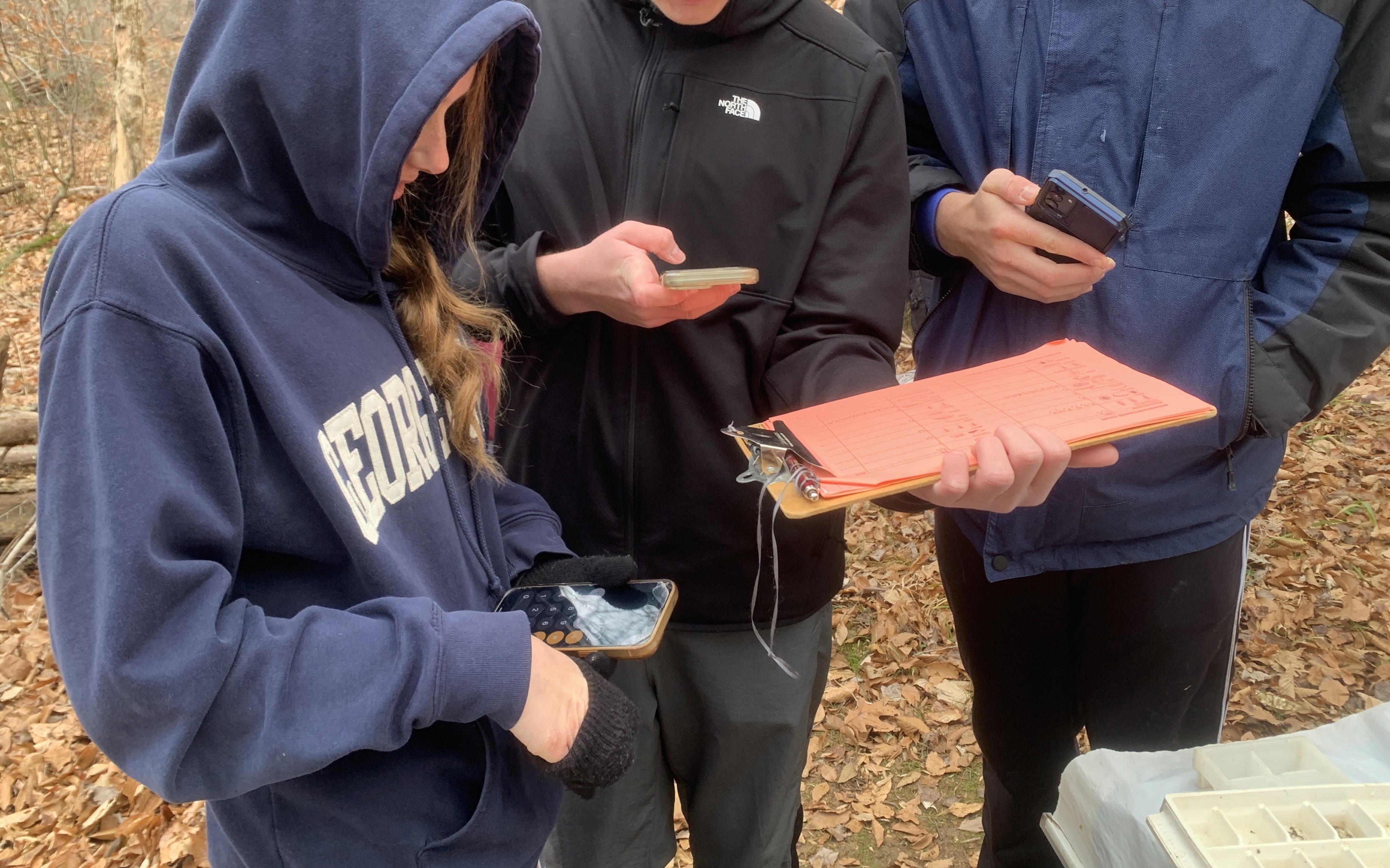 Three calculators are better than one as volunteers tabulate the results More Photos and Even More Photos |
December 13 2025 Stream Monitoring: The weather was overcast and chilly, with temperatures in the upper 30's. Still, conditions were otherwise good and we we certainly happy not to have tomorrow's forecast conditions of snow, wind, and temperatures only in the mid-20's. A Great blue heron flew directly overhead as we were getting started, boding well for the day. We needed to set three nets today to catch the minimum of 200 invertebrates required for a statistically valid sample. The catch was dominated by aquatic worms and Netspinner caddisflies, species that are tolerant of impaired waters. We did catch one exceptional Hellgammite, big as an adult's finger, plus a few Mayflies and a fair number of Riffle beetle larvae, species more indicative of healthy water. One unexpected species we collected in some abundance was beechnuts. Being tree seeds, rather than invertebrates, they have no effect on the score. However, a few brave volunteers did crack a few open to sample the contents and found them tasty enough, despite their soggy condition. Accotink Creek achieved a numeric stream health score of 4, down in the unacceptable range. Sediment caused by excessive runoff from paved surfaces is the major factor reducing invertebrate populations and impairing the health of streams in our region. See the tabulated results here.and on Clean Water Hub
Paved surfaces are the nemesis of Accotink Creek's benthic invertebrate population. Take advantage of financial incentives to become part of the solution with Conservation Assistance.
|
|
September 13, 2025, Stream Monitoring:
We were cautious to use gloves in the water and slather on the hand sanitizer, due to a recent toxic algae bloom in Lake Accotink, just upstream. Our catch today included representatives of some species we don't often encounter at this site - a damselfly larvae, a scud, a gilled snail, a ram's horn snail, and dozens of flatworms. Our catch was dominated, however, by midges and aquatic worms, species tolerant of impaired waters. We did not catch it in our net, but we were pleased to see a live adult freshwater mussel in the water. Our monitoring today produced a stream health score of 5, outside the acceptable threshold of nine on the 0 - 12 scale. See the tabulated results here.and on Clean Water Hub |
|
|
June 21, 2025 Stream Monitoring: It was a splendid day for monitoring, with sunny skies and temperatures rising into the mid 80's. The weather may have been too nice, since only three dedicated volunteers showed up. Today's session had been rescheduled from last week, due to high water conditions. Rain for most of the week gave us concern that we would be washed out again, but the creek had dropped enough that we encountered no challenge from water depth or current. We were fortunate to catch the full quota of over 200 invertebrates with just one net today, making this the fourth June in a row we've had that bit of luck. Our catch today was dominated by Netspinner caddisflies, a species tolerant of impaired water, and the one we catch most often. We caught a surprising number of Riffle beetle larva, amounting to just over 17% of our total. This is a species which requires better quality water than Accotink Creek can generally offer. Accotink Creek achieved a stream health score of 7 on the scale of 0 to 12, where 9 is the minimum score in the acceptable range.
|
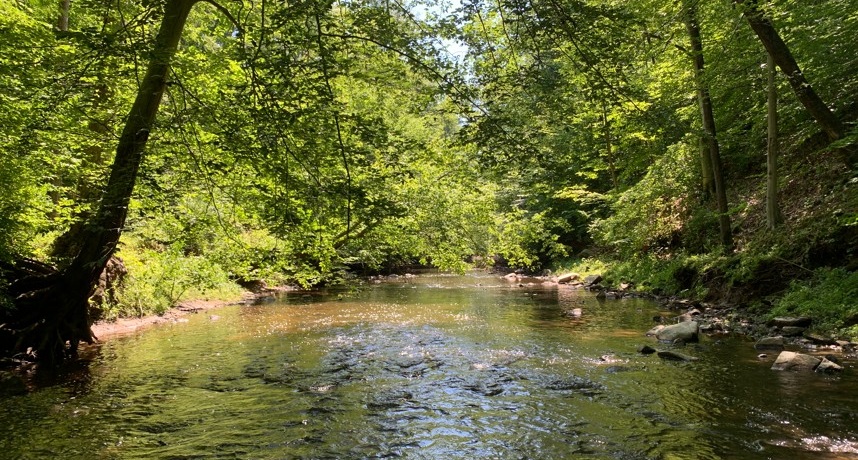 A beautiful day along Accotink Creek |
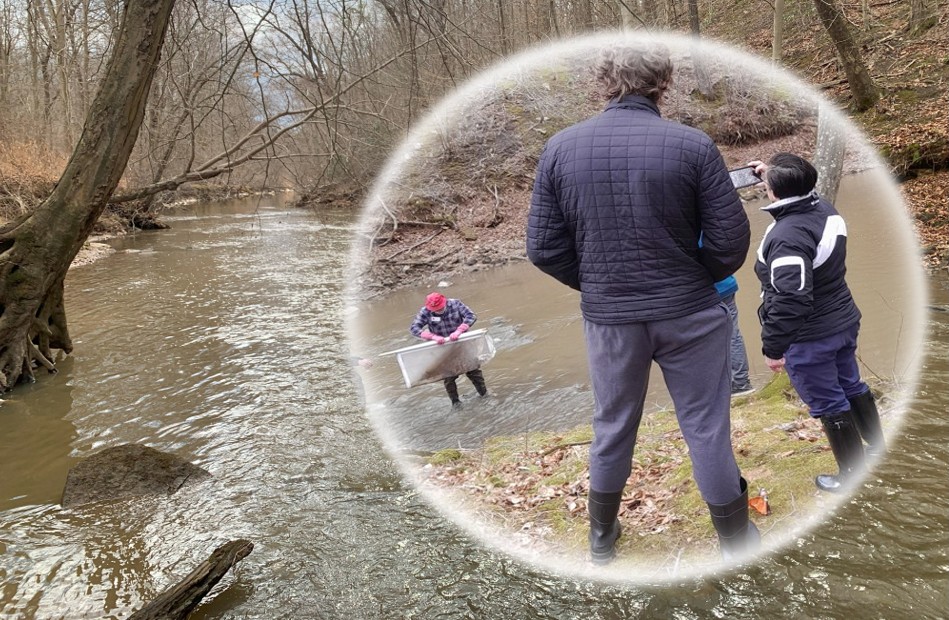 Late winter monitoring on a muddy Accotink Creek |
March 8, 2025 Stream Monitoring:
We had a crew of 6 volunteers today. The weather was favorable, overcast and cool, with temperatures rising to 47 degrees. Lake Accotink was making a rare release of water to allow for dam inspection. This made the water muddy and the current on the strong side. We still managed, with a bit of difficulty. We set the maximum of 4 nets to collect 209 invertebrates, just over the minimum of 200 required for a statistically valid sample. Our catch today included an encouraging number of riffle beetle larvae, a species intolerant of impaired waters. We had some unusual finds of species we don't often see, such as a single aquatic sowbug, a couple scuds, and a ramshorn snail. We also caught a crayfish for the third time in a row. Accotink Creek received a poor numeric stream health score of 4 on a scale of 0 to twelve, typical of the scores over the years at this site. See the tabulated results here and on Clean Water Hub
Paved surfaces are the nemesis of Accotink Creek's benthic invertebrate population. All the runoff during rainstorms pours down storm drains and shoots into the creek, scouring away the banks and smothering stream life in fine sediment. Take advantage of financial incentives to become part of the solution with Conservation Assistance.
|

|
Accotink Creek Creatures
A lament for aquatic invertebrates penned
GET YOUR BRAIN WET!
Plan now to volunteer again with others to preserve our oceans and waterways Back to our main Monitoring Page
|
 Our last measurable precipitation was late July, but the abundant rains of spring charged the aquifer enough to keep Accotink Creek flowing at a reduced, but steady, rate of flow. Weather was idyllic, with cooler early morning temperatures rising to about 80 degrees by the time we wrapped up. A great blue heron made a dramatic flyby as we were setting up, then foraged for fish a bit upstream while we worked.
 Still, 7 is the highest score Accotink Creek has achieved in the 20 years of monitoring at this site, so this was some small cause for celebration.

